Coupons Applicable on Checkout





Dowsing for Lost Objects -Your Intuitive Detective Guide
Why most lost-object dowsing attempts fail
Know these failure patterns to avoid them.
Emotional anxiety distorts readings
When you're anxious about finding something, your ideomotor responses amplify anxiety patterns rather than location signals. Calm state is prerequisite.
Vague question formulation
"Where is my phone?" is too broad. The object could be in multiple places, moved recently, or carried by someone else. Specific questions get specific answers.
No calibration before starting
Trying to locate lost objects without first confirming your yes/no calibration is working leads to unreliable results. Calibration takes 3 minutes; skipping it ruins the entire attempt.
Wrong tool for the application
Pendulums over a sketch/map work well. L-rods for on-site searching work well. Mixing inappropriately (pendulum while walking the house) adds interference.
Expectation bias
If you "know" the phone must be in the living room, your pendulum will confirm this suspicion rather than point to the true location. Must approach with genuinely open mind.
The 7-step lost-object dowsing protocol
Follow in exact sequence for highest success rate.
Step 1: Calm your emotional state
Take 5 minutes of slow breathing. If very upset or panicked, wait 15-30 minutes or next day. Anxious dowsing has near-zero success. Approach the search with curiosity and detachment, not desperation.
Step 2: Calibrate your pendulum
Standard calibration: "Show me yes" (pendulum swings in one direction), "Show me no" (opposite direction), "Show me maybe" (different movement). Confirm on 3 known-answer test questions. Only proceed when calibration is clear.
Step 3: Formulate specific questions
Write down: (1) Exactly what you're looking for (e.g., "my silver car keys with yellow keychain"), (2) When you last had it with certainty, (3) Where you've already searched. Being this specific enables targeted pendulum responses.
Step 4: Sketch a floor plan or map
Draw a rough sketch of your home, office, or the area you suspect. Include rooms, furniture locations, possible hiding spots. 10-minute sketch. This is your dowsing surface.
Step 5: Dowse over the sketch systematically
Hold pendulum over each room/area of the sketch, asking "Is my [object] in this area?" Mark yes responses with X. Often multiple rooms show positive that's normal (residual energy or multiple past locations).
Step 6: Refine with follow-up questions
Over each X-marked room, ask: "Is the object closer to the north/south wall?" "Is it on a surface or inside something?" "Is it visible without moving objects?" Narrows the search zone dramatically.
Step 7: Physical search with L-rods
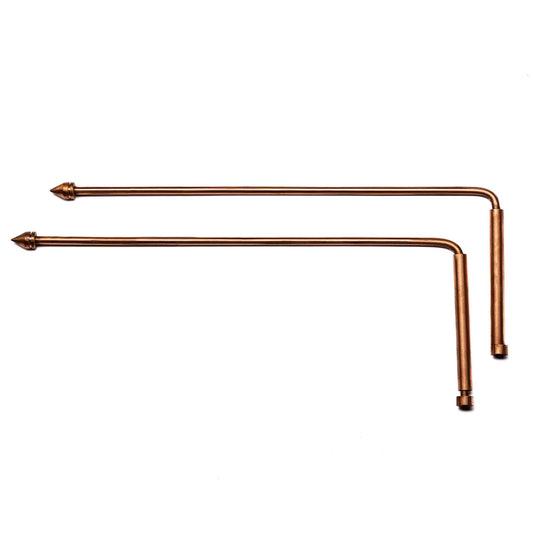
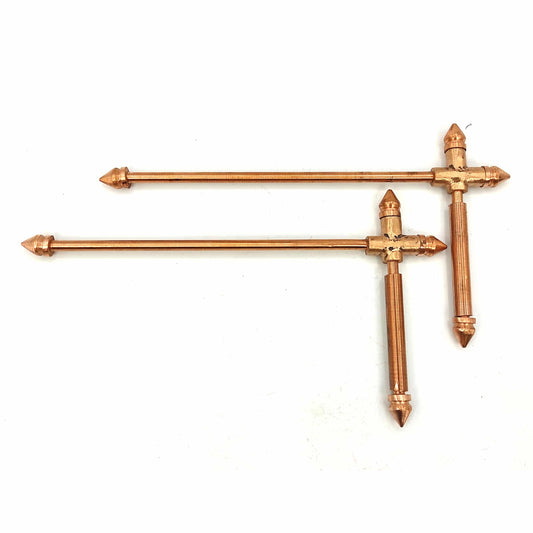
Move to the identified area with L-rods. Walk asking "Guide me to the [object]." Rods cross when you pass over or near the location. Follow them to the final spot. Expected time from sketch-dowsing to physical find: 10-30 minutes.
Special cases and advanced techniques
For situations beyond basic lost-object dowsing.
Object likely moved or taken by someone
If object may not be in your usual spaces, add questions: "Is my object in this building?" (scale up the map). "Did someone else move it?" "Is it currently with [family member name]?" Narrows to right location class before searching.
Lost pet dowsing
More challenging due to movement. Use area map rather than building floor plan. Ask about general direction and distance. Mark zones. Physically search highest-probability zones. Time-critical: dowse daily pet location changes.
Item lost outside home (in office, during travel)
Apply same 7-step protocol but sketch the relevant location (office, airport, mall). If location is inaccessible, dowse the sketch to narrow probable area, then contact that location's lost-and-found.
Very old lost item (years ago)
Older losses have dispersed energetic trails. Success rate drops to 40-50%. Ask: "Is this object still in this building?" If yes, proceed. If no, the item may have been discarded. Manage expectations not every lost item is findable through dowsing.
Multiple simultaneous lost items
Focus on one at a time. Complete the 7-step protocol for one item before starting the next. Trying to search for multiple items simultaneously splits focus and reduces accuracy for all.
Do's and Don'ts
About Nitien Parmar - Vastu Expert Since 1991
Nitien Parmar has practised Vastu since 1991 and has advised 10,000+ clients across 15+ countries. The remedies in this guide, including the helix directional remedies, follow the placement rules he uses in his own consultations.
Frequently asked questions
Serious about mastering lost-object dowsing?
For guidance on your own dowsing practice, book a personal consultation.